Author: Francisco

  • AI Writing in Cover Letters: How Recruiters Can Detect It

    detect AI writing in cover letters

    Learning how to detect AI writing in cover letters has become one of the most pressing challenges facing HR managers and recruiters in 2026. With candidates using ChatGPT and other AI writing tools to generate polished cover letters in seconds, hiring teams are increasingly struggling to identify which applicants have genuinely communicated their motivation and which have simply handed the task to an AI.

    Try Exolio AI free — no sign-up needed: app.exolio.com

    This guide explains why AI written cover letters are a problem, how to spot them, and how Exolio AI helps HR professionals detect AI writing in cover letters instantly.

    Why AI Written Cover Letters Are a Problem for Recruiters

    A cover letter exists for one reason — to give the recruiter a genuine sense of who the candidate is, why they want the role, and whether they can communicate clearly. When a candidate generates their cover letter using ChatGPT the result is polished and professional but it tells the recruiter nothing about the actual person.

    The problem goes deeper than just cover letters. AI is now being used to generate answers to application form questions, rewrite CV summaries, and produce work samples. A candidate who uses AI to write every part of their application is presenting a completely artificial version of themselves to the hiring team.

    For roles where written communication is a core skill — marketing, content, legal, finance, education — an AI written application is a direct misrepresentation of the candidate’s abilities. If they cannot write their own cover letter they may not be able to write the emails, reports and documents the role requires.

    How to Spot AI Writing in Cover Letters Manually

    Before using a detection tool there are several manual signals that suggest a cover letter was AI generated:

    Generic opening lines are the most common giveaway. Phrases like “I am writing to express my strong interest in this exciting opportunity” are classic AI outputs. Genuine candidates write more specifically about the role and company.

    Perfect structure with no personality — AI generated cover letters tend to follow a rigid three paragraph structure with an introduction, a skills paragraph and a closing. Human written letters are messier and more personal.

    No specific details — AI cannot know specific things about your company, your team or why this particular role appeals to the candidate. Vague references to “your innovative company” and “dynamic team environment” are strong signals of AI generation.

    Vocabulary that does not match the interview — if a candidate writes with sophisticated vocabulary and complex sentence structures in their cover letter but struggles to articulate themselves in interview that is a significant red flag.

    Buzzword heavy language — phrases like “results driven”, “passionate about excellence”, and “proven track record of success” appear constantly in AI generated applications because they appear constantly in the training data.

    How AI Detection Tools Help Recruiters

    Manual detection works for obvious cases but sophisticated candidates are increasingly using AI humaniser tools to make AI generated text harder to spot. These tools take AI output and rewrite it to bypass detection, making the cover letter feel more natural while still being entirely AI generated.

    This is where dedicated AI detection tools become valuable. Rather than relying on gut feeling alone, recruiters can paste any cover letter into an AI detector and get an objective probability score showing how likely the text is to be AI generated.

    The best tools go further than a simple percentage — they highlight specific sentences that flagged as AI generated, giving recruiters a clear breakdown of which parts of the application appear genuine and which appear AI written.

    How Exolio AI Detects AI Writing in Cover Letters

    Exolio AI is a free AI detection tool that works equally well on professional documents like cover letters and CV summaries as it does on academic writing. HR managers and recruiters paste any cover letter into the tool at app.exolio.com and receive an instant percentage score with colour coded sentence level highlighting.

    What makes Exolio AI different from other detectors is that it addresses the two biggest problems in AI detection. First, users can correct false positives when genuine human writing gets wrongly flagged — the model learns from these corrections over time making it more accurate. Second, users can flag text that has been run through an AI humaniser so the model gets better at catching it. This means Exolio AI improves continuously rather than giving the same wrong answers repeatedly.

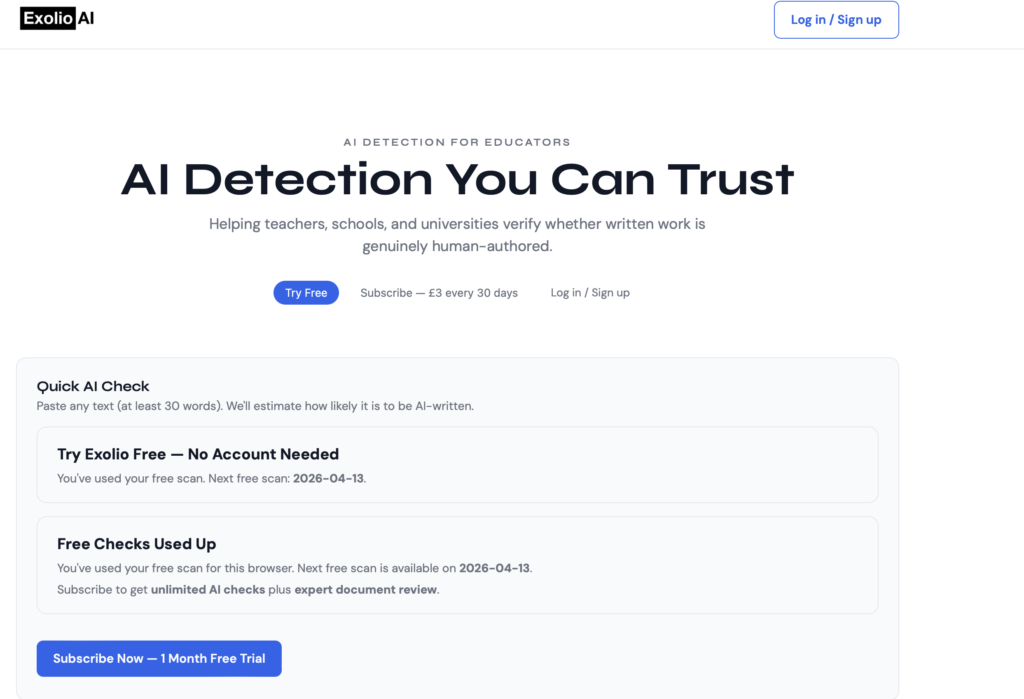
    The tool is free for the first month with no sign up required for your first check. After the free month unlimited checks are available for just £3 every 30 days — making it one of the most affordable options available for individual recruiters and HR teams.

    Best Practice for Using AI Detection in Recruitment

    AI detection scores should always be used as one signal among many rather than as definitive proof of anything. A high AI score on a cover letter should prompt you to ask more targeted questions at interview about the candidate’s motivation and communication skills rather than automatically disqualifying them.

    Combine the detector score with your own reading of the application. A cover letter that scores 85% AI and reads generically with no specific company knowledge is a much stronger signal than a 60% score on a letter that contains specific and personal details.

    Consider being transparent with candidates that AI detection is part of your screening process. This discourages AI generated applications from the outset and signals to genuine candidates that you value authentic communication.

    For roles where written communication is critical consider asking shortlisted candidates to complete a short written task at interview stage. This gives you a genuine writing sample to compare against their application and makes it much harder to rely on AI assistance.

    Try Exolio AI Free

    Exolio AI is free for the first month with no sign up required for your first check. Go to app.exolio.com, paste any cover letter and get an instant result with sentence level highlighting showing exactly which parts flagged as AI written.

    For unlimited checks subscribe for just £3 every 30 days — cancel any time.

  • AI Detector for Recruiters: How to Spot AI Written Cover Letters

    AI detector for recruiters

    An AI detector for recruiters has become an essential tool in 2026. With candidates increasingly using ChatGPT and other AI writing tools to generate cover letters, personal statements and application answers, recruiters are finding it harder than ever to identify genuine candidates from AI-generated ones.

    Try Exolio AI free — no sign-up needed: app.exolio.com

    This guide explains why AI detection matters in recruitment, what makes a good detection tool, and how Exolio AI helps recruiters verify whether a job application was genuinely written by the candidate.

    Why Recruiters Need an AI Detector in 2026

    The recruitment process relies on written applications to filter candidates before interview. Cover letters are supposed to reveal personality, motivation and communication skills. When a candidate generates their cover letter using ChatGPT the result is polished and professional but entirely generic — it tells the recruiter nothing about the actual person.

    The scale of the problem is significant. Surveys suggest over 60% of job seekers used AI to help write application materials in 2026. For recruiters handling hundreds of applications this means a large proportion of what they are reading was not written by the candidate at all.

    Beyond cover letters, AI is now being used to generate answers to application form questions, rewrite CV summaries, and even produce work samples and portfolio pieces. The challenge for recruiters is identifying which applications represent genuine candidates worth interviewing.

    The Biggest Problem With Most AI Detectors

    Most AI detection tools have two critical flaws that make them unreliable for recruitment use.

    The first is false positives. Some genuine human writing — particularly from candidates who write in a structured or formal style — gets wrongly flagged as AI-generated. This risks dismissing strong candidates unfairly based on an inaccurate score.

    The second is that most detectors can be fooled by AI humanisers. These are tools that take AI-generated text and rewrite it to bypass detection. A candidate can generate a cover letter with ChatGPT, run it through an AI humaniser, and most detectors will give it a low AI score even though the writing is entirely AI-generated.

    These two flaws mean that most detectors either flag too much — penalising genuine candidates — or miss too much — failing to catch candidates using sophisticated AI tools.

    How Exolio AI Is Different

    Exolio AI addresses both of these problems in a way that most detectors do not.

    On false positives — users can correct Exolio AI when it wrongly flags genuine human writing. The model learns from these corrections over time, becoming more accurate at distinguishing between human writing styles and AI-generated content. This means it gets better with use rather than repeating the same mistakes.

    On humaniser detection — users can flag text that has been run through an AI humaniser so the model learns to identify it. As humaniser tools become more sophisticated Exolio AI adapts alongside them rather than falling behind.

    What to Look For in an AI Detector for Recruiters

    When choosing an AI detector for recruitment use, look for these features:

    Accuracy on short documents — cover letters and application answers are shorter than academic essays. Many detectors are optimised for long form text and perform poorly on shorter documents. Exolio AI works well on both short and long form content.

    Sentence-level breakdown — a simple overall percentage score is not enough for making recruitment decisions. Seeing which specific sentences flagged as AI-generated gives you a more nuanced picture of the application.

    Speed — recruiters reviewing large volumes of applications need instant results. Exolio AI gives you a result in seconds with no uploads or lengthy processing required.

    Affordability — enterprise recruitment software can cost thousands of pounds per year. At just £3 every 30 days after a free first month, Exolio AI is accessible to individual recruiters and small agencies without a large procurement budget.

    How to Use AI Detection in Your Recruitment Process

    Introducing AI detection into your recruitment workflow does not need to be disruptive. Here are practical ways to use it:

    Run cover letters through an AI detector before shortlisting. A high AI score does not automatically disqualify a candidate but it should prompt more targeted questions at interview about their motivation and communication skills.

    Use it as one signal among many. Combine the detector score with your own reading of the application and your knowledge of the role. A score of 90% AI on a cover letter combined with a generic application form is a stronger signal than either alone.

    Ask shortlisted candidates to complete a short written task at interview. This gives you a genuine sample of their writing to compare against their application and makes it much harder to rely on AI assistance.

    Be transparent that AI detection is part of your process. This discourages AI-generated applications and signals that you value genuine communication over polished generic content.

    Getting Started With Exolio AI

    Try Exolio AI free at app.exolio.com — no account needed for your first check. Paste any cover letter or application answer and get an instant result showing how likely it is to be AI generated with specific sentences highlighted.

    For unlimited checks subscribe for just £3 every 30 days. Free for the first month with no credit card required until after your trial ends.

  • AI Detection for HR: Spotting AI Written Job Applications

    AI detection for HR

    AI detection for HR has become one of the fastest growing needs in recruitment in 2026. With candidates now using ChatGPT and other AI writing tools to generate entire cover letters, personal statements and even CV summaries in seconds, HR managers and recruiters are struggling to identify genuine applications from AI-generated ones.

    Try Exolio AI free — no sign-up needed: app.exolio.com

    This guide explains why AI detection matters in recruitment, how it works, and how HR professionals can use Exolio AI to verify whether a job application was genuinely written by the candidate.

    Why AI Detection for HR Matters in 2026

    The problem is straightforward. A candidate pastes a job description into ChatGPT and asks it to write a tailored cover letter. The result is polished, professional and entirely generic. It says exactly what the recruiter wants to hear — but it tells them nothing about the actual candidate.

    For HR managers trying to identify genuine talent, this creates a significant challenge. The cover letter is supposed to reveal personality, communication skills and genuine motivation. An AI-generated letter reveals none of these things.

    Beyond cover letters, AI is increasingly being used to rewrite CV summaries, generate answers to application form questions, and even produce work samples and portfolio pieces. The scale of the problem is significant — surveys suggest over 60% of job seekers have used AI to help write application materials in 2026.

    How AI Detection for HR Works

    AI detection tools analyse text for statistical and linguistic patterns that distinguish human writing from AI-generated content. When a person writes naturally they produce text with variation in sentence length, personal phrasing, occasional imperfections and a distinctive voice. AI-generated text tends to be more uniform, more polished and more predictable.

    Modern AI detection tools score text based on these patterns and return a probability score showing how likely the content is to have been written by an AI model. The best tools go further than a simple percentage — they highlight specific sentences that flagged as AI-generated, giving HR managers a clear visual breakdown of which parts of an application appear genuine and which appear AI-written.

    What HR Managers Should Look For

    Not every AI detection tool is suitable for HR use. When choosing an AI detection tool for recruitment, HR professionals should look for:

    Accuracy on short form text — cover letters and CV summaries are shorter than academic essays. Some tools perform poorly on shorter documents. Look for a tool specifically tested on short professional writing.

    Sentence-level breakdown — a simple percentage score is not enough for making recruitment decisions. You need to see which specific sentences flagged so you can make a more nuanced judgement about the application.

    Speed — HR managers reviewing dozens or hundreds of applications need a tool that gives instant results without requiring uploads or lengthy processing times.

    Affordability — enterprise HR software can cost thousands of pounds per year. Individual HR managers and small businesses need an affordable option that does not require a large procurement budget.

    How to Use AI Detection in Your Recruitment Process

    Introducing AI detection into your recruitment workflow does not need to be complicated or heavy handed. Here are some practical ways to use it:

    Run cover letters through an AI detector before shortlisting candidates. A high AI score does not automatically disqualify a candidate but it should prompt you to ask more probing questions in interview about their motivation and communication skills.

    Use it as one signal among many rather than a definitive verdict. Combine the detector score with your own reading of the application and what you know about the role and the candidate pool.

    Be transparent with candidates that AI detection is part of your process. This discourages lazy AI-generated applications and signals that you value genuine communication.

    Consider asking shortlisted candidates to complete a short written task at interview stage. This gives you a genuine sample of their writing to compare against their application.

    How Exolio AI Helps HR Managers

    Exolio AI is a free AI detection tool that works equally well for academic submissions and professional documents like cover letters and CV summaries. HR managers paste any text into the tool at app.exolio.com and receive an instant percentage score with colour-coded sentence-level highlighting.

    The tool is free for the first month with no sign-up required for your first check. After the free month unlimited checks are available for just £3 every 30 days — making it one of the most affordable AI detection options available for individual HR managers and small businesses.

    Getting Started

    Try Exolio AI free at app.exolio.com — no account needed for your first check. Paste any cover letter or CV summary and get an instant result showing how likely it is to be AI generated with the specific sentences highlighted.

    For unlimited checks subscribe for just £3 every 30 days. Free for the first month.

  • AI Detector for Essays: A Guide for Teachers

    AI detector for essays

    An AI detector for essays has become one of the most searched tools among teachers and lecturers in 2026. With students using ChatGPT and other AI writing tools to generate submitted work in seconds, educators need a reliable and affordable way to identify AI-generated content in student essays.

    👉 Try Exolio AI free — no sign-up needed: app.exolio.com

    This guide explains how AI essay detection works, what to look for in a detection tool, and how Exolio AI can help teachers identify AI writing instantly.

    Why Teachers Need an AI Detector for Essays

    The challenge facing teachers today is unlike anything seen before in education. Traditional plagiarism detection tools were designed to find copied content from existing sources. AI-generated essays are different — they are entirely original text, just not written by the student.

    This means tools like standard Turnitin checks are not sufficient on their own. Teachers need a dedicated AI checker for essays check student essays for AI that is trained specifically to identify the patterns and structures produced by large language models like ChatGPT, Claude, and Gemini.

    Without reliable detection, academic integrity is compromised and students who genuinely write their own work are disadvantaged against those using AI assistance without disclosure.

    How an AI Detector for Essays Works

    Modern AI detection tools analyse text for statistical and linguistic patterns that distinguish human writing from AI-generated content. These include:

    • Sentence structure consistency
    • Vocabulary predictability
    • Writing flow and variation
    • Burstiness — the natural variation in sentence length that human writers produce

    An AI detector for essays scores text based on these patterns and returns a probability score showing how likely the content is to have been generated by an AI model. The best tools go further than a simple percentage — they highlight specific sentences that flagged as AI-generated, giving teachers a clear visual breakdown of the text.

    What to Look for in an AI Essay Detector

    Not all AI detection tools are equal. When choosing an AI detector for essays, teachers should look for the following features:

    Sentence-level highlighting shows exactly which parts of an essay flagged as AI-generated rather than just giving an overall score. This is essential for having specific, evidence-based conversations with students.

    Percentage scoring gives a nuanced result rather than a binary yes or no verdict. A score of 45% AI is very different from a score of 95% AI and should be treated differently.

    Academic writing focus means the tool has been trained on academic essays and student submissions rather than general internet content, making it more reliable for educational use.

    Ease of use matters because teachers are busy. The best tools require no technical knowledge — just paste the text and get an instant result.

    Affordable pricing is critical for individual teachers who cannot access expensive institutional licences. A tool that costs hundreds of pounds per year is not accessible to most classroom teachers.

    Common Mistakes When Using AI Essay Detectors

    Teachers using an AI detector for essays for the first time sometimes make these mistakes:

    Treating the score as definitive proof is the most common error. AI detection scores should be used as a starting point for a conversation with the student, not as standalone evidence of academic dishonesty.

    Ignoring false positives is another risk. Some human writing — particularly from non-native English speakers or students with very structured writing styles — can score higher than expected. Always consider the score alongside your knowledge of the student and their previous work.

    Only checking suspicious essays means missing the broader picture. Running all submissions through an AI detector for essays gives you a baseline and helps identify patterns across a class rather than singling out individual students.

    How Exolio AI Detects AI-Written Essays

    Exolio AI is a free AI detector for teachers built specifically for text and academic institutions. Unlike general purpose detection tools, Exolio AI was trained on academic writing making it more reliable for checking student essays and reports.

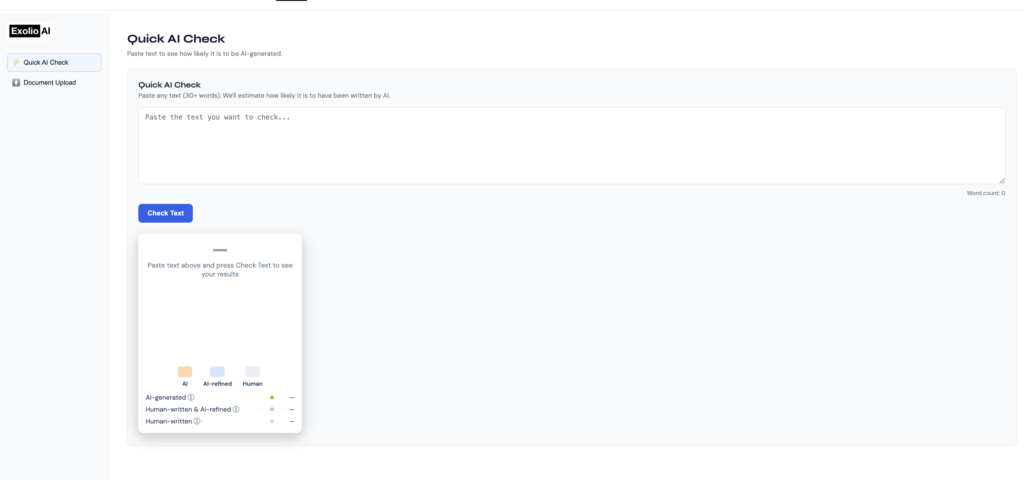
    Teachers paste any text into the tool at app.exolio.com and receive an instant percentage score with colour-coded sentence-level highlighting. Red highlighting indicates sentences that scored high for AI generation. Amber indicates AI-refined content. No highlight indicates human-written text.

    The tool is free for the first month with no sign-up required for your first check. After the free month unlimited checks are available for just £3 every 30 days — significantly more affordable than institutional alternatives.

    Getting Started with AI Essay Detection

    Introducing AI detection into your marking workflow does not need to be complicated. Start by running a few essays you are already suspicious of through an AI detector for essays to get a feel for the results. Then gradually incorporate it into your regular marking process.

    Communicate clearly with students that AI detection is part of your assessment process. Transparency around detection policies reduces the likelihood of students attempting to use AI without disclosure in the first place.

    Try Exolio AI free at app.exolio.com — no account needed for your first check. For unlimited essay checks subscribe for just £3 every 30 days.

  • AI Plagiarism Checker: Essential Tool for Modern Educators

    AI Plagiarism Checker: Essential Tool for Modern Educators

    Best AI detector

    An AI plagiarism checker has become an indispensable tool for educators navigating the challenges of artificial intelligence in academic settings. With students increasingly using AI writing tools like ChatGPT and Claude for assignments, teachers need reliable methods to identify AI-generated content and preserve academic integrity.

    👉 Try Exolio AI free — no sign-up needed: app.exolio.com

    Traditional plagiarism detection tools excel at finding copied content from existing sources, but they struggle with AI-generated text that appears original. This gap creates significant challenges for educators who must adapt their assessment methods to address this new form of academic dishonesty.

    How an AI Plagiarism Checker Works

    Modern AI detection systems use sophisticated machine learning algorithms to analyse text patterns that distinguish human writing from AI-generated content. These tools examine various linguistic features, including sentence structure, vocabulary choices, and writing flow patterns that are characteristic of different AI models.

    The technology works by training on vast datasets of both human-written and AI-generated text, learning to identify subtle differences that human readers might miss. This includes detecting repetitive phrasing, unnatural transitions, and the distinctive “voice” that AI tools often produce.

    Effective AI plagiarism checker tools combine multiple detection methods to improve accuracy. They analyse statistical patterns, semantic structures, and stylistic elements to provide comprehensive assessments of content authenticity.

    Why Educators Need Reliable Detection Tools

    The rise of AI writing tools presents unprecedented challenges for maintaining academic standards. Students can now generate essays, reports, and assignments within minutes, making it increasingly difficult for teachers to identify authentic student work through manual review alone.

    Academic integrity extends beyond preventing copied content—it encompasses ensuring that submitted work genuinely represents a student’s own thinking and learning process. When students rely heavily on AI-generated content without proper disclosure, they miss crucial opportunities for skill development and critical thinking.

    Furthermore, assessment validity depends on accurately measuring student capabilities. If undetected AI assistance skews evaluation results, it undermines the entire educational process and creates unfair advantages for some students over others.

    Key Features of Effective AI Detection

    Professional-grade detection tools offer several essential capabilities that basic checkers often lack. Real-time analysis provides immediate feedback, allowing teachers to quickly assess suspicious content during the marking process.

    Detailed reporting features help educators understand why content flagged as potentially AI-generated, providing specific examples and confidence scores. This transparency enables informed decision-making when discussing results with students.

    Integration with common educational platforms streamlines workflow, allowing teachers to check submissions without disrupting their existing marking processes. Many tools also support various file formats, accommodating different assignment types and submission methods.

    Accuracy remains paramount—false positives can damage student-teacher relationships, while false negatives allow academic dishonesty to go undetected. The best tools continuously update their algorithms to maintain high detection rates whilst minimising incorrect flagging.

    Implementing AI Detection in Educational Settings

    Successful implementation requires clear communication with students about expectations and detection policies. Establishing transparent guidelines helps create awareness about AI use whilst maintaining trust in the assessment process.

    Teachers should understand that ChatGPT detection and similar AI identification processes work best as part of comprehensive academic integrity strategies rather than standalone solutions. Combining detection tools with varied assessment methods creates more robust evaluation systems.

    Training staff on proper tool usage ensures consistent application across departments and courses. Understanding tool limitations and interpreting results accurately helps avoid misunderstandings and maintains fairness in academic evaluation.

    Regular policy updates reflect evolving AI capabilities and changing educational needs. As AI technology advances, detection methods and academic policies must adapt accordingly to remain effective.

    Consider implementing an AI detector for students as part of educational programmes that teach responsible AI use rather than simply prohibiting all AI assistance.

    Best Practices for Teachers

    Effective use of AI detection tools requires balancing technological capabilities with pedagogical judgment. Results should inform conversations with students rather than automatically determining penalties, allowing for contextual consideration of individual circumstances.

    Document detection results systematically to support academic integrity processes and provide evidence when necessary. Maintaining clear records helps ensure consistency and fairness across similar cases.

    Stay informed about AI development trends and detection tool updates. The rapidly evolving landscape requires ongoing professional development to maintain effective assessment practices.

    Encourage open dialogue about AI use in education, helping students understand ethical boundaries whilst recognising legitimate applications. This approach fosters responsible technology use rather than creating adversarial relationships.

    Try Exolio AI Free

    Exolio AI is free to try with one check available and no sign-up required. Visit app.exolio.com for an instant result. For unlimited checks and document upload with expert review, subscribe for just £3 every 30 days.

  • Detect AI Writing in Essays: A Complete Guide for UK Teachers

    Detect AI Writing in Essays: A Complete Guide for UK Teachers

    detect AI writing in essays

    The ability to detect AI writing in essays has become an essential skill for educators across the UK as artificial intelligence tools become increasingly sophisticated. With students having access to advanced AI writing assistants, teachers and lecturers need reliable methods to identify potentially generated content whilst maintaining fairness and supporting genuine learning.

    👉 Try Exolio AI free — no sign-up needed: app.exolio.com

    The rise of AI-generated content in academic submissions presents both challenges and opportunities for educational institutions. Understanding how to spot AI-generated text helps maintain academic integrity while ensuring students develop critical thinking and writing skills essential for their future careers.

    Why Teachers Need Reliable Detection Tools

    Academic integrity forms the foundation of quality education. When students submit AI-generated work as their own, they miss crucial learning opportunities and undermine the assessment process. The Department for Education guidance on AI emphasises the importance of maintaining standards while adapting to technological advances.

    Beyond integrity concerns, identifying AI-generated content helps teachers understand when students might need additional support with writing skills. Rather than purely punitive measures, detection can open conversations about proper AI use and academic development.

    The skills students develop through authentic writing practice—critical analysis, argument construction, and clear communication—remain vital regardless of technological advances. These abilities transfer to professional contexts where original thinking and clear expression are valued.

    Common Signs That Help Detect AI Writing in Essays

    Experienced educators often develop an intuitive sense for identifying potentially AI-generated submissions. Several patterns frequently appear in artificially generated text that can alert teachers to investigate further.

    AI writing often exhibits unusually consistent quality throughout lengthy pieces, lacking the natural fluctuations typical of human writing. Students might produce work significantly above their demonstrated ability level, with sophisticated vocabulary and complex sentence structures that seem inconsistent with their previous submissions.

    Generic examples and broad statements without specific personal insights or local references can indicate AI generation. Artificial intelligence often produces content that sounds authoritative but lacks the nuanced understanding and personal perspective expected from genuine student work.

    Repetitive phrasing patterns and unnaturally smooth transitions between paragraphs may also suggest AI involvement. Human writing typically includes minor inconsistencies and personal voice elements that AI struggles to replicate authentically.

    Effective Strategies for Educators

    Successful identification requires combining multiple approaches rather than relying on single indicators. Professional AI detection tool options provide technological support, but human expertise remains crucial for accurate assessment.

    Comparing submissions against students’ previous work helps identify significant changes in writing style, complexity, or approach. Sudden improvements or shifts in voice might indicate external assistance or AI generation.

    Asking targeted questions about specific content can reveal whether students truly understand their submitted work. If learners cannot explain their reasoning or discuss particular examples in detail, this might suggest they didn’t create the content themselves.

    Reviewing the writing process through draft submissions and planning documents provides insight into how ideas developed. AI-generated content typically appears without the iterative development visible in authentic student work.

    Using Technology to Detect AI Writing in Essays

    Modern detection tools offer valuable support for educators managing large numbers of submissions. An AI detector for students can provide initial screening while teachers apply professional judgement to interpret results appropriately.

    Technology works best when combined with pedagogical expertise rather than replacing human assessment entirely. Detection tools can flag potentially problematic submissions for closer review, but context and educational goals should guide final decisions.

    Regular use of detection technology also helps teachers stay current with evolving AI capabilities and detection methods. As artificial intelligence advances, both generation and identification techniques continue developing.

    The most effective approach involves establishing clear policies about AI use while providing students with guidance about appropriate integration of technological tools in their learning process.

    Try Exolio AI Free

    Exolio AI is free to try with one check available and no sign-up required. Visit app.exolio.com for an instant result. For unlimited checks and document upload with expert review, subscribe for just £3 every 30 days.

  • AI Writing Detector: The Teacher’s Guide to Spotting AI Content

    AI writing detector

    An AI writing detector has become one of the most important tools available to teachers in 2026. As AI writing tools become faster and more convincing, the ability to identify AI-generated student work quickly and reliably is no longer optional — it is essential.

    👉 Try Exolio AI free — no sign-up needed: app.exolio.com

    This guide explains how an AI writing detector works, what makes a good one, and how to use it effectively in an academic setting.

    What Is an AI Writing Detector?

    This type of tool analyses text and estimates the probability that it was generated by an AI model such as ChatGPT, Claude, or Gemini. It identifies patterns in sentence structure, word choice, and writing style that are characteristic of AI rather than human authors.

    Exolio AI is a free AI writing detector built specifically for teachers and academic institutions. Paste any text into the tool at app.exolio.com and receive an instant result — no account needed.

    Why Teachers Need an AI Writing Detector

    The scale of AI use in student work has grown dramatically since 2023. A reliable detection tool gives teachers an evidence-based starting point for further investigation rather than relying on gut instinct alone.

    Used responsibly, an AI writing detector supports fair and consistent marking across a whole class or department. It also acts as a deterrent — students who know their work may be checked are less likely to submit AI-generated content.

    How to Check Student Work for AI Writing

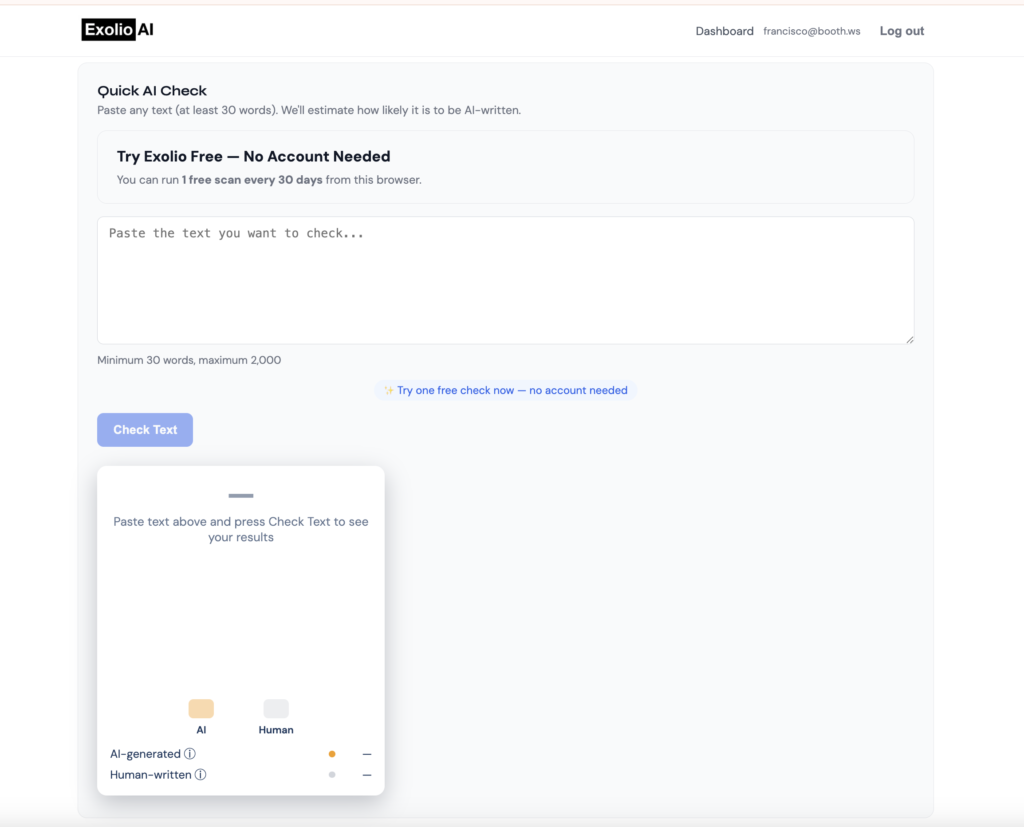
    Go to app.exolio.com and paste the text you want to check into the Quick AI Check box. Click Check Text and receive an instant result within seconds.

    Here is how to interpret the score:

    0 to 40 percent — the text is likely human-written. Proceed with normal marking.

    40 to 65 percent — the result is mixed. Some AI-like patterns are present but not conclusive. Consider reviewing the work more closely or asking the student follow-up questions.

    65 percent and above — the text shows strong signs of AI generation. This warrants closer investigation before making any formal decision.

    Key Features to Look For

    Speed — a good tool should return results in seconds. Exolio AI produces an instant result as soon as you click Check Text.

    Academic focus — the best option for teachers should be trained on academic writing specifically. Exolio AI is trained on thousands of examples of both human and AI-generated academic text.

    Clear results — a percentage score with a colour-coded breakdown is more useful than a simple yes or no answer. It gives you context for further investigation.

    No barriers — Exolio AI offers one free check with no sign-up required. Subscribers get unlimited checks for just £3 every 30 days.

    Important Limitations to Keep in Mind

    No detection tool is perfect. Heavily edited AI text, formally structured academic writing, and writing in a second language can all produce ambiguous results. Always use detection as one tool among many rather than as the sole basis for any formal decision.

    For high-stakes cases, Exolio AI’s document upload service provides a deeper level of analysis. Upload a PDF or Word document and our expert team will manually review it and deliver a detailed report by email.

    For more on spotting AI content manually, read our guide on how to check if text is AI generated. For specific guidance on ChatGPT in student work, see our post on ChatGPT essay detector.

    Key Features to Look For

    Exolio AI offers one free check with no sign-up required. Visit app.exolio.com to get started.

    For unlimited checks and document upload with expert review, subscribe for just £3 every 30 days.

  • ChatGPT Essay Detector: Spot AI Writing Instantly – Exolio.com

    ChatGPT essay detector

    A ChatGPT essay detector has become one of the most requested tools in education since ChatGPT made AI writing accessible to millions of students overnight. Teachers who once relied on writing style and gut instinct now need a more reliable method to identify AI-written submissions.

    👉 Try Exolio AI free — no sign-up needed: app.exolio.com

    This guide explains how a ChatGPT essay detector works, what to look for in a reliable tool, and how to use results responsibly in an academic setting.

    How a ChatGPT Essay Detector Works

    A ChatGPT essay detector analyses text and identifies patterns that are characteristic of AI-generated writing. ChatGPT and other large language models produce text with distinctive patterns in sentence structure, vocabulary choice, and writing style that differ from genuine student writing.

    Exolio AI is a free ChatGPT essay detector built specifically for academic use. Paste any essay or written submission into the tool at app.exolio.com and receive an instant result showing the likelihood of AI generation — no account needed.

    Signs That an Essay Was Written by ChatGPT

    Before using a ChatGPT essay detector, there are manual signs to look for:

    Unnaturally consistent tone — ChatGPT produces writing with a remarkably even tone throughout. Human student writing naturally varies in energy, formality, and sentence complexity.

    Generic and safe content — ChatGPT tends to make broad claims rather than specific personal observations. If an essay reads like a polished encyclopedia entry rather than a student’s original thinking, that is worth investigating.

    Overuse of transitional phrases — ChatGPT frequently uses phrases like “it is important to note”, “furthermore”, and “in conclusion” with a regularity that differs from typical student writing.

    Perfect structure — ChatGPT essays tend to follow a very clean introduction, body, conclusion format with balanced paragraph lengths. Genuine student writing is rarely this consistently structured.

    How to Use a ChatGPT Essay Detector

    Go to app.exolio.com and paste the essay text into the Quick AI Check box. Click Check Text and receive an instant result within seconds.

    Here is how to interpret the score:

    0 to 40 percent — the essay reads as human-written. Proceed with normal marking.

    40 to 65 percent — the result is mixed. Some AI-like patterns are present but not conclusive. Consider asking the student to explain their argument verbally.

    65 percent and above — the essay shows strong signs of ChatGPT or AI generation. This warrants closer investigation before making any formal decision.

    What to Do With a High Score

    A high score from a ChatGPT essay detector is not proof of academic misconduct. It is a reason to investigate further. Ask the student to walk you through their argument, describe their research process, or answer specific questions about the content.

    Combine tool-based detection with your own professional judgement and give students the opportunity to respond before taking any formal action.

    Document Upload for Formal Cases

    For high-stakes academic integrity cases, Exolio AI’s document upload service provides a deeper level of analysis than a standard ChatGPT essay detector. Upload a PDF or Word document and our expert team will manually review it using multiple detection methods and deliver a detailed report by email.

    Turnaround times: under 1,000 words within 24 hours, 1,000 to 5,000 words within 48 hours, 5,000 to 10,000 words within 72 hours, and over 10,000 words within one week.

    For broader guidance on detection tools, read our post on the best AI detector for teachers. For step by step instructions on checking text manually, see our guide on how to check if text is AI generated.

    Try the Free ChatGPT Essay Detector

    Exolio AI offers one free check with no sign-up required. Visit app.exolio.com to get an instant result.

    For unlimited checks and document upload with expert review, subscribe for just £3 every 30 days.

  • AI Detection Tool: How to Check Student Work for AI Writing

    AI detection tool

    An AI detection tool has become essential for teachers and educators trying to maintain academic integrity in 2026. As AI writing becomes more sophisticated and harder to spot manually, having a reliable AI detection tool saves time and gives you an evidence-based starting point for further investigation.

    👉 Try Exolio AI free — no sign-up needed: app.exolio.com

    This guide explains how an AI detection tool works, what to look for when choosing one, and how to use results responsibly in an academic setting.

    How an AI Detection Tool Works

    An AI detection tool analyses text and estimates the probability that it was written by an AI model such as ChatGPT, Claude, or Gemini. It works by identifying patterns in word choice, sentence structure, and writing style that are characteristic of AI rather than human authors.

    Exolio AI is a free AI detection tool built specifically for academic use. Paste any text into the tool at app.exolio.com and receive an instant result showing the likelihood of AI generation — no account needed.

    What to Look for in an AI Detection Tool

    Not all detection tools are equal. When choosing an AI detection tool for academic use, look for these qualities:

    Academic training — the best tool for checking student work should be trained on academic writing specifically, not just general web content. Exolio AI is trained on thousands of examples of academic and professional text.

    Clear scoring — a percentage score is more informative than a simple yes or no verdict. It gives you context for further investigation rather than a binary decision.

    No sign-up barrier — the best option should let you check text immediately without creating an account. Exolio AI offers one free check with no registration required.

    Transparent methodology — a trustworthy tool should explain how it works. Exolio AI uses a custom machine learning model and presents results as a clear percentage score with a colour-coded breakdown.

    How to Use Exolio AI

    Go to app.exolio.com and paste the text you want to check into the Quick AI Check box. Click Check Text and receive an instant result within seconds.

    Here is how to interpret the score:

    0 to 40 percent — the text is likely human-written. Proceed with normal marking.

    40 to 65 percent — the result is mixed. Some AI-like patterns are present but not conclusive. Consider reviewing specific sections more closely or asking the student follow-up questions.

    65 percent and above — the text shows strong signs of AI generation. This warrants closer investigation before making any formal decision.

    Using an AI Detection Tool Responsibly

    Any detection tool is a starting point for investigation, not a final verdict. A high score does not automatically mean a student cheated. Heavily edited AI text, formal academic writing, and writing in a second language can all produce higher scores.

    Always combine tool-based detection with your own professional judgement and give students the opportunity to respond before taking any formal action.

    Document Upload for Deeper Analysis

    For high-stakes academic integrity cases, Exolio AI’s document upload service provides a deeper level of analysis than the standard AI detection tool. Upload a PDF or Word document and our expert team will manually review it using multiple detection methods and deliver a detailed report by email.

    Turnaround times: under 1,000 words within 24 hours, 1,000 to 5,000 words within 48 hours, 5,000 to 10,000 words within 72 hours, and over 10,000 words within one week.

    For more on choosing the right tool, read our guide on the best AI detector for teachers. For advice on building a detection policy at institutional level, see our post on AI detection for universities.

    Try the Free AI Detection Tool

    Exolio AI offers one free check with no sign-up required. Visit app.exolio.com to get started.

    For unlimited checks and document upload with expert review, subscribe for just £3 every 30 days.

  • AI Content Detector Free: Check Any Text Without Paying


    AI content detector free

    Finding a reliable AI content detector free to use is harder than it sounds. Many tools advertise free access but then limit results, require sign-up, or push you towards a paid plan before you can see your score. This guide explains what to look for in a genuinely free AI content detector and how to get an instant result right now.

    👉 Try Exolio AI free — no sign-up needed: app.exolio.com

    What Is an AI Content Detector Free to Use?

    An AI content detector free to use is a tool that analyses text and estimates whether it was written by a human or generated by an AI model such as ChatGPT, Claude, or Gemini — without requiring payment or registration to see the result.

    Exolio AI offers one free content detection check with no account needed. Go to app.exolio.com, paste your text, and receive an instant percentage score showing the likelihood of AI generation.

    How to Use a Free AI Content Detector

    Go to app.exolio.com and paste the text you want to check into the Quick AI Check box. Click Check Text. The tool will return a result within seconds.

    Here is how to interpret the score:

    0 to 40 percent — the text is likely human-written.

    40 to 65 percent — the result is mixed. Some AI-like patterns are present but not conclusive.

    65 percent and above — the text shows strong signs of AI generation.

    What to Watch Out for With Free AI Detection Tools

    Not every AI content detector free to use is genuinely useful. Here are the most common issues to watch for:

    Results hidden behind a paywall — some tools show you a loading bar and then ask you to pay to see the result. Exolio AI shows your result immediately with no payment required for your free check.

    Sign-up required before checking — creating an account adds friction and means sharing your email before you have seen any value. Exolio AI requires no sign-up for your free check.

    No explanation of methodology — a trustworthy AI content detector free or paid should explain how it works. Exolio AI uses a custom machine learning model trained on thousands of examples of both human and AI-generated text.

    Limited to short texts — some free tools cap the amount of text you can check. Exolio AI accepts any length of text for your free check.

    When to Upgrade Beyond the Free Check

    One free check is enough to test the tool and get a result for a single piece of text. For teachers, lecturers, or content reviewers checking multiple documents regularly, a subscription makes more sense.

    Exolio AI’s subscription costs just £3 every 30 days and includes unlimited text checks and document upload with expert review by email. For anyone checking student work regularly, this is the most cost-effective option available.

    For more on using AI detection in education, read our guide on AI detector for teachers. For step by step instructions on checking text manually, see our post on how to check if text is AI generated.

    Try the Free AI Content Detector

    Exolio AI is free to use with one check available and no sign-up required. Visit app.exolio.com for an instant result.

    For unlimited checks and document upload with expert review, subscribe for just £3 every 30 days.