
AI detection for universities has become one of the most pressing challenges facing academic institutions since the widespread adoption of AI writing tools. Students can now generate entire essays in seconds, and the results are increasingly difficult to distinguish from genuine student work.
👉 Try Exolio AI free — no sign-up needed: app.exolio.com
This guide explains how AI detection for universities works, what institutions should look for in a detection tool, and how to use results within an academic integrity framework.
Why AI Detection for Universities Matters
The scale of the problem means that individual lecturers checking work manually is no longer sufficient. AI detection for universities needs to be fast, accessible, and reliable enough to support formal academic integrity processes.
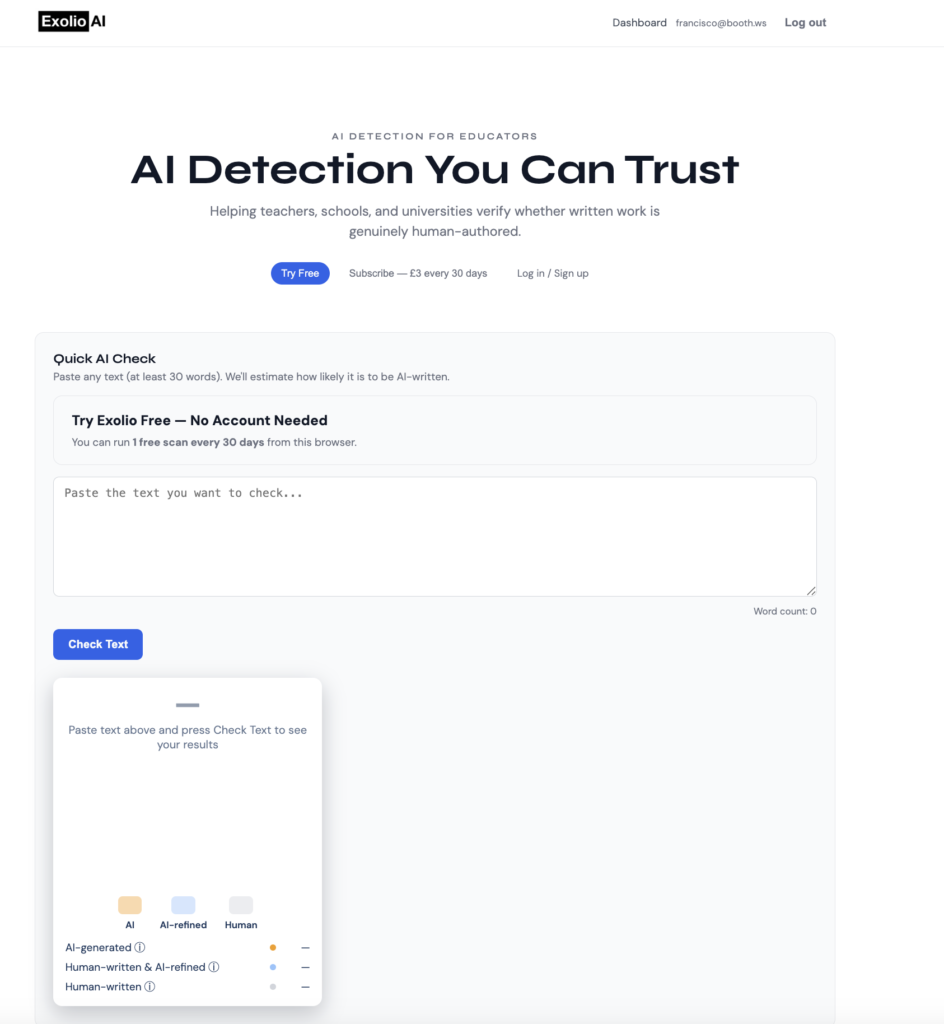
Exolio AI provides instant AI detection for universities and individual academic staff. Paste any submission into app.exolio.com and receive a percentage score showing the likelihood of AI generation within seconds.
How AI Detection for Universities Works
Exolio AI uses a custom machine learning model trained on thousands of examples of both human and AI-generated academic text. When text is submitted, the tool analyses patterns in word choice, sentence structure, and writing style to produce a probability score.
The score is presented as a percentage between 0 and 100. Here is how to interpret it:
0 to 40 percent — the text reads as human-written. No further action required.
40 to 65 percent — the result is mixed. Some AI-like patterns are present. Consider requesting the student explain their work or submit supporting materials.
65 percent and above — the text shows strong signs of AI generation. This warrants formal investigation under your institution’s academic integrity policy.
Building an AI Detection Policy
Effective AI detection for universities requires more than just a tool. Institutions should consider these elements when building a policy:
Clear student guidance — students should know your institution’s position on AI use. The QAA has published guidance on academic integrity that is worth referencing. Publish your policy prominently and refer to it in assignment briefs.
Consistent application — detection should be applied consistently across departments and assessment types to avoid claims of unfair treatment.
Human review — no detection tool is perfect. All results should be reviewed by a qualified member of academic staff before any formal action is taken.
Right of reply — students should always have the opportunity to respond to detection results before any disciplinary process begins.
Document Upload for Formal Reviews
For high-stakes academic integrity cases, Exolio AI’s document upload service provides a deeper level of analysis. Upload a PDF or Word document and our expert team will manually review it using multiple detection methods and deliver a detailed report by email.
Turnaround times are as follows: under 1,000 words within 24 hours, 1,000 to 5,000 words within 48 hours, 5,000 to 10,000 words within 72 hours, and over 10,000 words within one week.
For more guidance on detection tools, read our post on AI detector for teachers. For practical advice on spotting AI writing manually, see our guide on how to tell if an essay is AI written.
For practical advice on checking individual essays, read our guide on AI checker for essays.
For broader guidance on detection tools, see our post on AI detector for teachers.
Try AI Detection for Universities
Exolio AI offers one free check with no sign-up required. Visit app.exolio.com to get started.
For unlimited checks and document upload, subscribe for just £3 every 30 days.
Leave a Reply