Finding the best AI detector for teachers means looking beyond headline claims and understanding what actually matters for classroom use. The best AI detector for teachers will be accurate, easy to use, and designed with academic integrity in mind.
This guide explains what to look for when choosing a detection tool and how Exolio AI compares.
Speed and simplicity — teachers are busy. A good detection tool should produce a result in seconds without requiring technical setup or lengthy onboarding. Exolio AI returns a result within seconds of pasting text.
What the Best AI Detector for Teachers Should Do
Academic focus — general purpose detectors are trained on a wide variety of content including web articles and social media posts. The best AI detector for teachers should be trained specifically on academic writing to produce more reliable results on student essays and reports.
Clear results — a percentage score is more useful than a binary yes or no answer. It gives teachers a starting point for further investigation and a basis for a constructive conversation with the student.
No unnecessary barriers — a good tool should be accessible from any browser with no downloads or complex setup. Exolio AI offers one free check with no sign-up required.
Expert review for high stakes cases — for formal academic integrity investigations, a manual expert review is more reliable than an automated score alone. Exolio AI’s document upload service provides a detailed expert report by email.
How Exolio AI Compares to Other Tools
Exolio AI was built specifically for educators and academic institutions. It uses a custom machine learning model trained on thousands of examples of both human and AI-generated academic text, making it one of the most reliable options for checking student work.
Results are presented as a clear percentage score with a colour-coded breakdown showing whether the text is likely human written, mixed, or AI generated. Subscribers get unlimited checks and document upload with expert review included for just £3 every 30 days.
How to Use Exolio AI
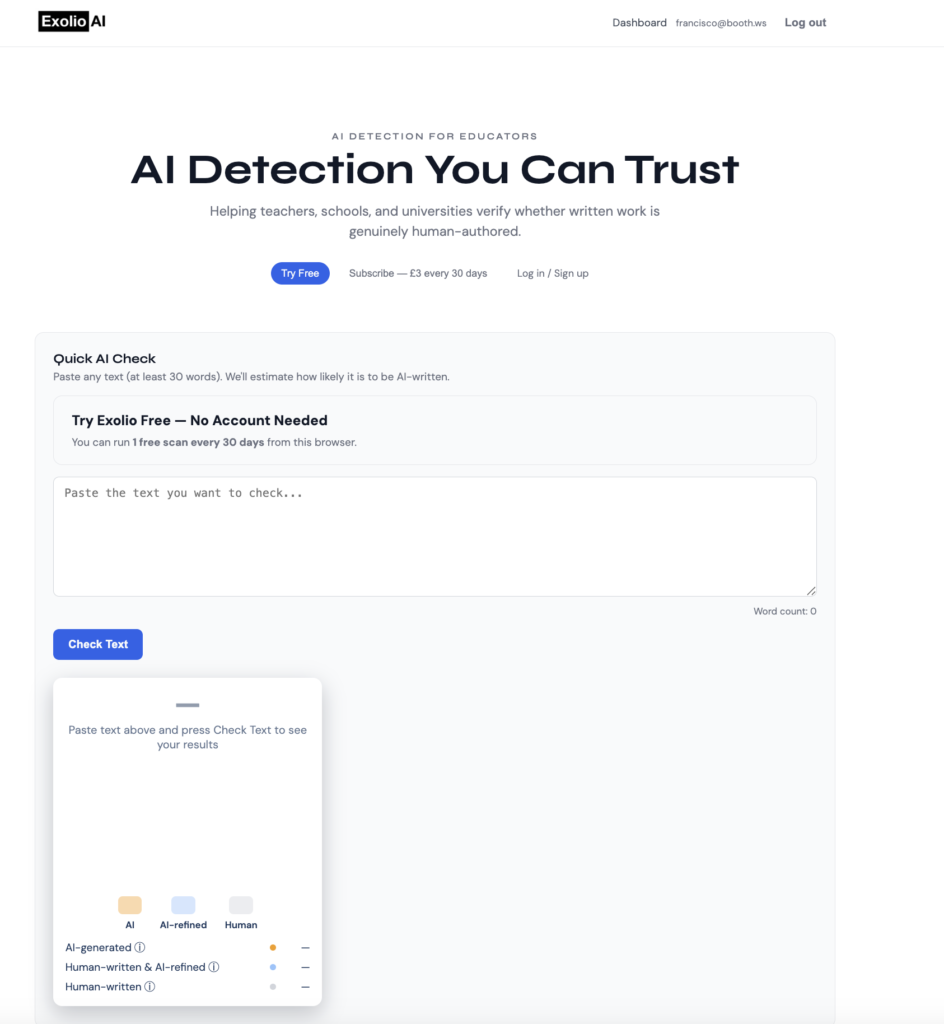
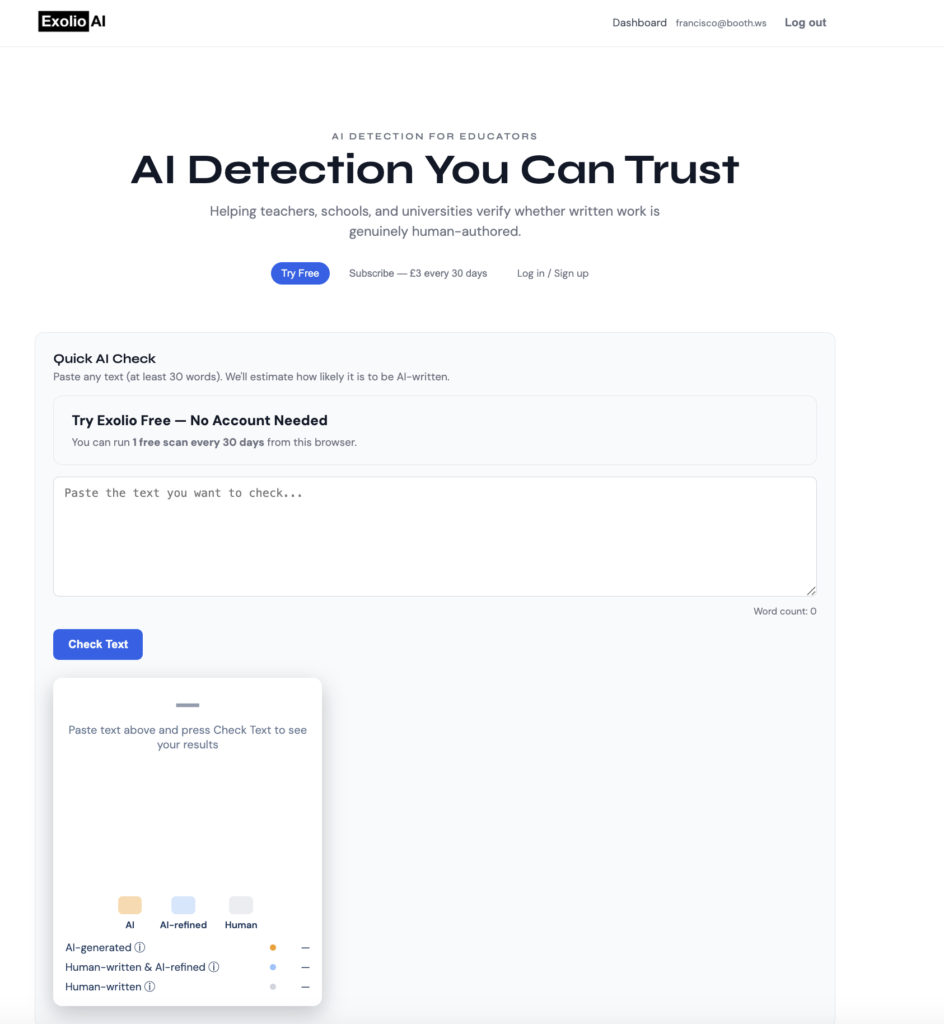
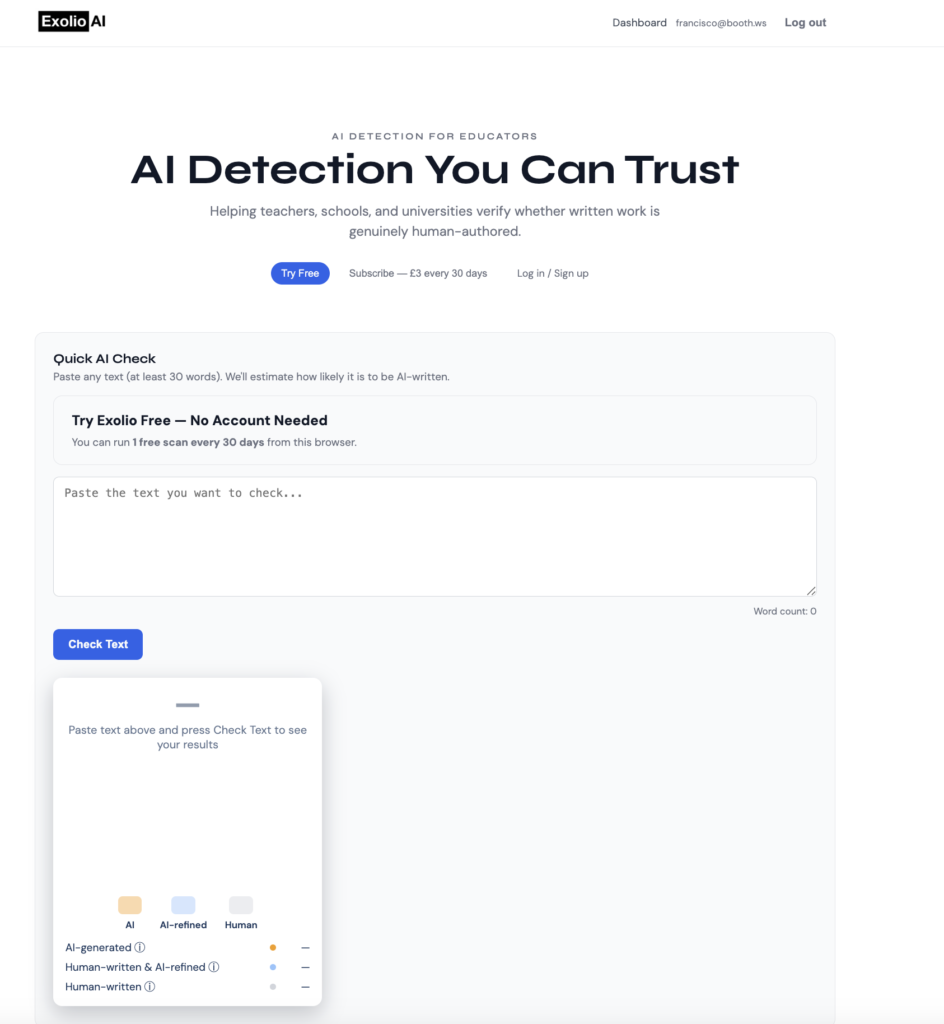
Go to app.exolio.com and paste the student’s text into the Quick AI Check box. Click Check Text and receive an instant result. One free check is available with no account needed.
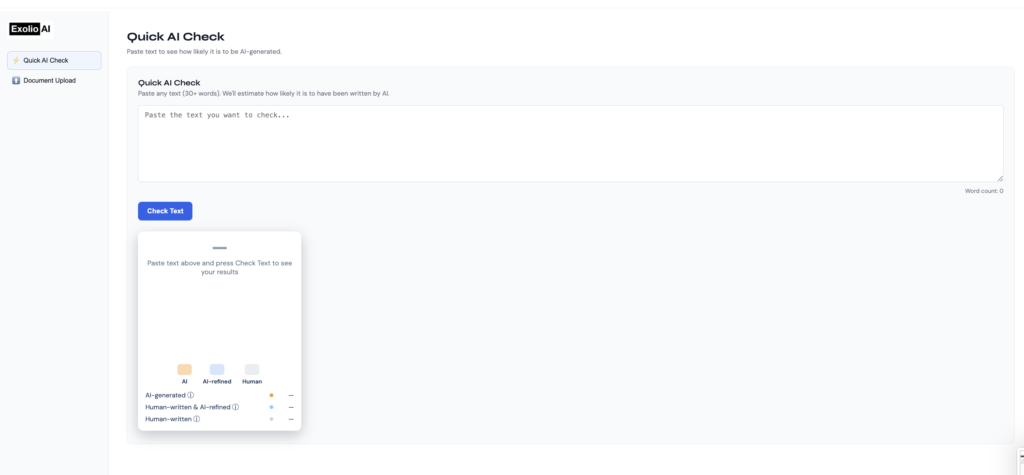
For document upload and expert review, log in to your dashboard and select Document Upload. Upload a PDF or Word file and our team will review it and deliver a detailed report by email.
Using Detection Results Responsibly
Even the best AI detector for teachers is a tool to support professional judgement, not replace it. Always use results as a starting point for further investigation and give students the opportunity to respond before taking any formal action.
For more on the practical use of detection tools, read our guide on AI checker for essays. For advice on building a detection policy at institutional level, see our post on AI detection for universities.
Try the Best AI Detector for Teachers
Exolio AI offers one free check with no sign-up required. Visit app.exolio.comto get started.
For unlimited checks and document upload with expert review, subscribe for just £3 every 30 days.
Knowing how to check if text is AI generated has become an essential skill for teachers, academics, editors, and employers. AI writing tools now produce text that can be difficult to distinguish from human writing at first glance but there are reliable methods for identifying it.
This guide covers both manual techniques and tool-based approaches to help you check if text is AI generated quickly and confidently.
How to Check if Text Is AI Generated Manually
Before using any tool, there are patterns you can look for yourself when trying to check if text is AI generated.
Consistent tone throughout — human writers naturally shift in tone, energy, and style across a long piece. AI-generated text tends to maintain a remarkably even tone from start to finish with little variation.
Overly safe and generic content — AI writing tends to make broad claims rather than specific personal observations. The MIT Media Lab has published research on the patterns that distinguish AI from human writing. If the text reads like a polished summary rather than an original perspective, that is worth noting.
Repetitive sentence structure — AI models often produce sentences of similar length and complexity. Look for a lack of variation between short punchy sentences and longer more detailed ones.
Common AI phrases — watch for expressions like “it is important to note that”, “in today’s rapidly changing world”, or “there are many factors to consider”. These appear frequently in AI-generated text.
Lack of specific detail — AI writing stays broad and avoids specific dates, names, local references, or personal anecdotes. Genuine human writing tends to include concrete specifics.
How to Check if Text Is AI Generated Using a Tool
Manual review has limits, especially when checking large volumes of text. A dedicated detection tool removes the guesswork and gives you a clear result in seconds.
Go to app.exolio.com and paste the text into the Quick AI Check box. Click Check Text and Exolio AI will return a percentage score showing how likely the text is to be AI generated.
Here is how to read the result:
0 to 40 percent — the text is likely human-written.
40 to 65 percent — the result is mixed. Some AI-like patterns are present but not conclusive.
65 percent and above — the text shows strong signs of AI generation and warrants closer investigation.
What to Do With the Result
Once you know how to check if text is AI generated, the next step is using that information appropriately. A high score is a reason to investigate further, not a final verdict. Combine tool-based results with your own judgement and, where appropriate, a direct conversation with the author.
For academic contexts, read our guide on AI detection for universities for advice on building a fair and consistent detection policy. For practical advice on essay-specific detection, see our post on AI checker for essays.
Exolio AI is free to use with one check available and no sign-up required. Visit app.exolio.com for an instant result.
For unlimited checks and document upload with expert review, subscribe for just £3 every 30 days.
POST 11
Title: Best AI Detector for Teachers: What to Look for and How to Choose
Focus keyphrase: best AI detector for teachers
Meta description: Looking for the best AI detector for teachers? This guide explains what to look for and why Exolio AI is built specifically for academic use.
Slug: best-ai-detector-for-teachers
Finding the best AI detector for teachers means looking beyond headline claims and understanding what actually matters for classroom use. Not all detection tools are built the same way, and the best AI detector for teachers will be accurate, easy to use, and designed with academic integrity in mind.
This guide explains what to look for when choosing the best AI detector for teachers and how Exolio AI compares.
What the Best AI Detector for Teachers Should Do
Speed and simplicity — teachers are busy. The best AI detector for teachers should produce a result in seconds without requiring technical setup or lengthy onboarding. Exolio AI returns a result within seconds of pasting text.
Academic focus — general purpose detectors are trained on a wide variety of content including web articles, marketing copy, and social media posts. The best AI detector for teachers should be trained specifically on academic and professional writing to produce more reliable results on student essays and reports.
Clear results — a percentage score is more useful than a binary yes or no answer. It gives teachers a starting point for further investigation and a basis for a constructive conversation with the student.
No unnecessary barriers — the best AI detector for teachers should be accessible from any browser with no downloads or complex setup. Exolio AI offers one free check with no sign-up required.
Expert review for high stakes cases — for formal academic integrity investigations, a manual expert review is more reliable than an automated score alone. Exolio AI’s document upload service provides a detailed expert report by email.
How Exolio AI Compares
Exolio AI was built specifically for educators and academic institutions. It uses a custom machine learning model trained on thousands of examples of both human and AI-generated academic text, making it one of the most reliable options for checking student work.
Results are presented as a clear percentage score with a colour-coded label showing whether the text is likely human-written, mixed, or AI-generated. Subscribers get unlimited checks and document upload with expert review included for just £3 every 30 days.
How to Use Exolio AI
Go to app.exolio.com and paste the student’s text into the Quick AI Check box. Click Check Text and receive an instant result. One free check is available with no account needed.
For document upload and expert review, log in to your dashboard and select Document Upload. Upload a PDF or Word file and our team will review it and deliver a detailed report by email.
Using Detection Results Responsibly
Even the best AI detector for teachers is a tool to support professional judgement, not replace it. Always use results as a starting point for further investigation and give students the opportunity to respond before taking any formal action.
For more on the practical use of detection tools, read our guide on AI checker for essays. For advice on building a detection policy at institutional level, see our post on AI detection for universities.
Try the Best AI Detector for Teachers
Exolio AI offers one free check with no sign-up required. Visit app.exolio.comto get started.
For unlimited checks and document upload with expert review, subscribe for just £3 every 30 days.
AI detection for universities has become one of the most pressing challenges facing academic institutions since the widespread adoption of AI writing tools. Students can now generate entire essays in seconds, and the results are increasingly difficult to distinguish from genuine student work.
This guide explains how AI detection for universities works, what institutions should look for in a detection tool, and how to use results within an academic integrity framework.
Why AI Detection for Universities Matters
The scale of the problem means that individual lecturers checking work manually is no longer sufficient. AI detection for universities needs to be fast, accessible, and reliable enough to support formal academic integrity processes.
Exolio AI provides instant AI detection for universities and individual academic staff. Paste any submission into app.exolio.com and receive a percentage score showing the likelihood of AI generation within seconds.
How AI Detection for Universities Works
Exolio AI uses a custom machine learning model trained on thousands of examples of both human and AI-generated academic text. When text is submitted, the tool analyses patterns in word choice, sentence structure, and writing style to produce a probability score.
The score is presented as a percentage between 0 and 100. Here is how to interpret it:
0 to 40 percent — the text reads as human-written. No further action required.
40 to 65 percent — the result is mixed. Some AI-like patterns are present. Consider requesting the student explain their work or submit supporting materials.
65 percent and above — the text shows strong signs of AI generation. This warrants formal investigation under your institution’s academic integrity policy.
Building an AI Detection Policy
Effective AI detection for universities requires more than just a tool. Institutions should consider these elements when building a policy:
Clear student guidance — students should know your institution’s position on AI use. The QAA has published guidance on academic integrity that is worth referencing. Publish your policy prominently and refer to it in assignment briefs.
Consistent application — detection should be applied consistently across departments and assessment types to avoid claims of unfair treatment.
Human review — no detection tool is perfect. All results should be reviewed by a qualified member of academic staff before any formal action is taken.
Right of reply — students should always have the opportunity to respond to detection results before any disciplinary process begins.
Document Upload for Formal Reviews
For high-stakes academic integrity cases, Exolio AI’s document upload service provides a deeper level of analysis. Upload a PDF or Word document and our expert team will manually review it using multiple detection methods and deliver a detailed report by email.
Turnaround times are as follows: under 1,000 words within 24 hours, 1,000 to 5,000 words within 48 hours, 5,000 to 10,000 words within 72 hours, and over 10,000 words within one week.
For more guidance on detection tools, read our post on AI detector for teachers. For practical advice on spotting AI writing manually, see our guide on how to tell if an essay is AI written.
Teachers and lecturers are increasingly turning to an AI checker for essays as part of their marking process. With AI writing tools now capable of producing convincing academic prose in seconds, having a reliable way to check student submissions has become essential.
This guide explains how an this tool works, what to look for in a good tool, and how to use results responsibly.
What Is an AI Checker for Essays?
An AI checker for essays is a tool that analyses written text and estimates the probability that it was generated by an AI model such as ChatGPT, Claude, or Gemini. It works by identifying patterns in sentence structure, word choice, and writing style that are characteristic of AI rather than human authors.
Exolio AI is a tool built specifically for academic use. Paste any essay or written submission into the tool at app.exolio.com and receive an instant percentage score showing how likely the text is to be AI-generated.
How to Use an AI Checker for Essays
Go to app.exolio.com and paste the essay text into the Quick AI Check box. Click Check Text and the tool will return a result within seconds.
Here is how to interpret the score:
0 to 40 percent — the essay reads as human-written. Proceed with normal marking.
40 to 65 percent — the result is mixed. Some AI-like patterns are present but the result is not conclusive. Consider reviewing specific sections more closely.
65 percent and above — the essay shows strong signs of AI generation. This warrants a conversation with the student before any formal decision is made.
What Makes a Reliable AI Checker for Essays
Not every AI checker for essays is suited to academic use. When choosing a tool, look for these qualities:
Trained on academic writing — general purpose detectors may not perform as well on formal essay writing. Exolio AI is trained specifically on academic and professional text.
Clear percentage score — a numerical result is more useful than a simple yes or no. It gives you context for further investigation.
No sign-up required — Exolio AI offers one free check from any browser with no account needed.
Expert review option — for high-stakes decisions, Exolio AI’s document upload service provides a detailed expert review by email.
Using Results Responsibly
Exolio AI is a starting point, not a verdict. A high score warrants further investigation but is not proof of academic misconduct on its own. Always combine tool-based detection with your professional judgement and a conversation with the student.
For more on spotting AI writing manually, read our guide on how to tell if an essay is AI written. For broader guidance on AI detection tools, see our post on AI detector for teachers.
An AI detector for students has become an essential tool in 2026. Whether you have used AI to help draft an essay or simply want to check that your writing does not read as AI-generated, running a quick check before submission can save you from unnecessary questions later.
This guide explains how an AI detector for students works, when to use one, and what to do with the results.
Why Students Should Use an AI Detector
Many universities and schools now have policies requiring students to declare any use of AI in their work. Even if you only used AI for light editing or to get ideas, it is worth checking your final submission to understand how it might appear to a detection tool.
An AI detector for students helps you do exactly that. Paste your text, get a result, and decide whether to revise before submitting.
How to Use an AI Detector for Students
Go to app.exolio.com and paste your text into the Quick AI Check box. Click Check Text and within seconds you will see a percentage score showing how likely your text is to be AI-generated.
Here is how to read the result:
0 to 40 percent — your writing reads as human-written. You are in a good position to submit.
40 to 65 percent — your writing shows some AI-like patterns. Consider reviewing and rewriting sections to make them sound more personal and specific.
65 percent and above — your writing has strong AI-like patterns. It is worth revising before submitting, regardless of how you wrote it.
What to Do If Your Score Is High
A high score does not automatically mean you used AI. Formal academic writing, heavily structured essays, and writing in a second language can all produce higher scores. However if your score is high and you want to reduce it, here are some practical steps:
Add specific personal examples or references to your own experience. AI writing tends to be generic personal detail makes writing read as more human.
Vary your sentence length. AI models often produce sentences of similar length and complexity. Mix short punchy sentences with longer more detailed ones.
Use your own voice. If you naturally use informal phrases or specific expressions, include them. AI writing tends to avoid colloquialisms.
Reference specific sources, dates, or local context. AI writing stays broad and safe specificity is a strong human signal.
Is It Cheating to Check Your Own Work?
No. Using an AI detector for students to review your own work before submission is no different from using a spell checker or grammar tool. You are simply making sure your work is presented in the best possible way.
Many students use Exolio AI proactively to check drafts before submitting, especially when working on important assignments or dissertations.
Try the Free AI Detector for Students
Exolio AI offers one free check with no sign-up required. Go to app.exolio.com, paste your text, and get an instant result.
For unlimited checks throughout the academic year, subscribe for just £3 every 30 days.
A free AI writing detector has become one of the most searched-for tools among teachers, academics, and content reviewers in 2026. As AI writing tools become more sophisticated, the ability to check text quickly and reliably is essential.
This guide explains what a free AI writing detector does, how to use one, and what to look for when choosing the right tool.
How Does AI Text Detection Work?
A free AI writing detector is a tool that analyses text and estimates the likelihood that it was written by an AI model such as ChatGPT, Claude, or Gemini. It works by scanning patterns in word choice, sentence structure, and writing style that differ between human and AI-generated content.
Exolio AI is built specifically for educators and academic institutions. Paste any text into the tool at app.exolio.com and receive an instant result showing the probability of AI generation — no account needed.
How to Use a Free AI Writing Detector
Using Exolio AI takes seconds. Go to app.exolio.com, paste the text you want to check, and click Check Text. The tool returns a percentage score between 0 and 100.
Here is how to interpret the result:
0 to 40 percent — the text is likely human-written. Proceed with normal review.
40 to 65 percent — the result is mixed. The text shows some AI-like patterns but is not conclusive. Consider asking follow-up questions or reviewing the work more closely.
65 percent and above — the text shows strong signs of AI generation. This warrants closer investigation before making any formal decision.
What Makes a Good Detection Tool
Not all free AI writing detectors are equal. When choosing a tool, look for these qualities:
No sign-up required — the best tools let you check text immediately without creating an account. Exolio AI offers one free check with no registration.
Clear results — a percentage score is more useful than a simple yes or no answer. It gives you a starting point for further investigation rather than a binary verdict.
Built for your use case — general-purpose AI detectors are trained on a wide variety of text. Exolio AI is trained specifically on academic and professional writing, making it more reliable for checking student essays and reports.
Transparent methodology — a trustworthy tool should explain how it works. Exolio AI uses a custom machine learning model trained on thousands of examples of both human and AI-generated text.
Limitations of Any Free AI Writing Detector
No free AI writing detector is perfect. Heavily edited AI text, formally structured academic writing, and AI-assisted drafting can all produce ambiguous results. Always use detection as one tool among many rather than as the sole basis for any decision.
For more reliable results on important documents, consider Exolio AI’s document upload service. Our expert team manually reviews your document using multiple detection methods and delivers a detailed report by email. Subscribers get unlimited text checks and document upload included.
Try the Free AI Writing Detector
Exolio AI is free to use with no sign-up required. One free text check is available from any browser at app.exolio.com.
For unlimited checks and document upload with expert review, subscribe for just £3 every 30 days.
Knowing how to tell if an essay is AI written has become one of the most important skills for teachers in 2026. AI writing tools are faster, more fluent, and harder to spot than ever. But there are still reliable signs to look for.
This guide covers the manual signs of AI writing and how to use a detection tool to confirm your suspicions.
How to Tell if an Essay Is AI Written: The Manual Signs
Before using any tool, there are patterns you can look for yourself.
Unnaturally consistent tone. Human writers shift in energy and tone across a long piece. AI-generated essays tend to maintain a remarkably even tone from start to finish, with little variation in sentence complexity or emotional register.
Generic rather than specific. AI writing tends to make broad, safe claims rather than offering specific personal insights. If an essay reads like a well-written Wikipedia summary rather than a student’s original thinking, that is worth investigating.
Overly polished language. Student writing typically contains minor imperfections — slightly awkward phrasing, informal word choices, uneven paragraph lengths. AI-generated text often reads too smoothly, with consistently sophisticated vocabulary and perfect structure.
Hedging phrases. AI models frequently use phrases like “it is important to note that,” “in today’s rapidly evolving world,” or “there are many factors to consider.” These appear with frequencies that differ from typical student writing.
How to Tell if an Essay Is AI Written Using a Detection Tool
Manual detection has limits, especially when marking dozens of essays. This is where an AI detection tool like Exolio AI can help.
Paste the essay text into Exolio AI at app.exolio.com and you will receive a percentage score showing how likely the text is to be AI-generated. The tool analyses patterns in word choice, sentence structure, and writing style that are characteristic of AI versus human authors.
One free check is available with no account needed.
What to Do With the Result
A high AI probability score is not proof of cheating. It is a reason to have a conversation with the student. Ask them to explain their argument verbally, describe their research process, or answer specific questions about the content.
You may also want to let students know they can use our AI detector for students to review their own work before submission.
Understanding how to tell if an essay is AI written means combining tool-based detection with your own professional judgement. No single method is conclusive on its own.
AI writing tools have changed the classroom overnight. For teachers trying to uphold academic integrity, having a reliable AI detector for teachers is no longer optional — it is essential.
This guide explains what to look for in an AI detection tool, how to use one effectively, and what to do when you get a result.
What Should an AI Detector for Teachers Do?
A good AI detector for teachers should be fast, simple to use, and accurate enough to give you a meaningful starting point for further investigation. It should not require technical knowledge or lengthy setup.
Exolio AI is designed with exactly this in mind. Paste any text — a student essay, a paragraph, or a short response — and get an instant result showing how likely it is to have been written by AI. One free check is available with no account needed.
How to Use an AI Detector for Teachers
Using Exolio AI takes seconds. Go to app.exolio.com, paste the text you want to check, and click Check Text. The tool will return a percentage score showing the likelihood of AI generation.
A high score does not automatically mean a student cheated. Use the result as a starting point for a conversation, not as a verdict. Ask the student to explain their argument or walk you through their research process.
What Results Mean
Exolio AI returns a percentage score between 0 and 100. Here is how to interpret it:
0 to 40 percent — the text is likely human-written. Proceed with normal marking.
40 to 65 percent — the result is mixed or uncertain. The text shows some AI-like patterns but is not conclusive. Consider asking follow-up questions.
65 percent and above — the text shows strong signs of AI generation. This warrants closer investigation before making any formal decision.
When Detection Gets Difficult
No AI detector for teachers is perfect. Some scenarios make detection harder for large language models like ChatGPTand others. Heavily edited AI text, formal academic writing, and AI-assisted drafting can all produce ambiguous results. Always use detection as one tool among many, not as the sole basis for academic integrity decisions.
Best Practices for Teachers
Set clear expectations with students about your AI policy before assignments are submitted. Design assignments that require personal reflection, specific references to class discussions, or analysis of unique source materials — these are harder to complete with AI alone.
Keep samples of earlier student work for comparison. A sudden jump in writing quality is worth investigating regardless of what any detection tool says.
Try Exolio AI Free
Exolio AI is a free AI detector for teachers with no sign-up required. One free check is available from any browser. Subscribers get unlimited checks and document upload with detailed expert review by email.
AI Writing vs Human Writing: How to Tell the Difference
Can you tell if a piece of text was written by a person or by an AI? It is getting harder. The differences between AI writing vs human writing are shrinking as tools like ChatGPT, Claude, and Gemini produce increasingly fluent prose that can fool casual readers. But real differences still exist and understanding them matters.
Whether you are a teacher checking student work, an editor reviewing submissions, or simply curious about what you are reading online, knowing how to distinguish AI from human writing is a valuable skill.
The Core Differences Between AI Writing vs Human Writing
At a fundamental level, AI and humans approach writing differently. Humans write from experience, knowledge, and intention. AI generates statistically probable sequences of words based on patterns in its training data. This difference shows up in several ways.
Voice and Personality
Human writing has personality. Every writer has habits favourite words, characteristic sentence lengths, recurring ways of structuring arguments. Read a few pages by any author and you start to recognise their voice.
AI writing lacks this consistency of character. It can imitate different styles when prompted, but it does not have a natural voice of its own. The result often reads as competent but generic like a well-educated person trying very hard not to reveal anything about themselves.
Specificity and Detail
Human writers draw on personal experience, specific memories, and particular observations. A student writing about a novel might reference a specific passage that confused them or connect a theme to something that happened in their own life.
AI writing tends to stay at a higher level of abstraction. It can make accurate general points, but it struggles to provide the kind of specific, grounded detail that comes from genuine engagement with a subject.
Emotional Range
Human writing reflects genuine emotional states. Frustration, enthusiasm, uncertainty, and humour all show up naturally in human prose, often without the writer consciously intending it.
AI can simulate emotional language, but it tends to do so in predictable ways. Its expressions of emotion often feel performative rather than authentic the right words in the right order, but without the underlying feeling.
Imperfection
Perhaps the most telling difference is imperfection. Human writing contains minor inconsistencies, slightly awkward transitions, occasional repetition, and uneven quality. These imperfections are not bugs they are features of authentic human expression.
AI writing is often suspiciously clean. Paragraphs are well-balanced, transitions are smooth, and the quality is remarkably consistent from beginning to end. This uniformity, paradoxically, is what makes it detectable.
Patterns That AI Detection Tools Look For
Modern AI detection tools analyse text for statistical patterns that distinguish AI from human writing. Here are some of the key signals.
Perplexity. This measures how predictable the text is. AI-generated text tends to have lower perplexity its word choices are more statistically expected. Human writing is more surprising, with higher variability in word selection.
Burstiness. Human writing varies in sentence length and complexity. Some sentences are short and punchy; others are long and complex. AI tends to produce more uniform sentence structures.
Vocabulary distribution. AI models favour common, safe word choices. Human writers are more likely to use unusual words, technical jargon, slang, or creative language.
Structural patterns. AI often follows predictable structural templates introduction, several body paragraphs of similar length, conclusion. Human writing is more likely to deviate from standard templates.
When Detection Gets Difficult
Some scenarios make it genuinely hard to distinguish AI from human writing.
Heavily edited AI text. If someone generates AI text and then substantially edits it restructuring paragraphs, replacing words, adding personal details the result is a hybrid that may not trigger detection.
Formal human writing. Highly formal, polished human writing (academic papers, legal documents, professional reports) can look similar to AI output because both prioritise clarity and correctness over personality.
AI-assisted writing. Many people now use AI as a writing tool rather than a replacement generating outlines, getting suggestions for phrasing, or using AI to polish drafts. The line between “AI-written” and “AI-assisted” is blurry.
Why It Matters
The ability to distinguish AI from human writing matters for several reasons.
Academic integrity. Students who submit AI-generated work without disclosure undermine the educational process and gain an unfair advantage.
Content authenticity. As AI-generated content floods the internet, being able to identify it helps readers evaluate the credibility and originality of what they read.
Professional standards. In journalism, publishing, and other writing-dependent fields, the distinction between human and AI authorship has ethical and legal implications.
How Exolio AI Can Help
Exolio AI uses a custom machine learning model to analyse text and estimate the probability that it was AI-generated. The system examines patterns in word choice, sentence structure, and writing style across the entire text. If you’re ready to test a piece of text, learn how to detect AI-generated text using Exolio’s free tool. For a more specific look at ChatGPT detection, see our dedicated guide.
You get a percentage score a confidence meter showing how likely the text is to be human-written or AI-generated. It takes seconds and works with any text of 30 words or more.
Quick AI Check — paste text and get an instant result. One free check available, no sign-up required.
Document Upload — subscribers can upload full documents for detailed analysis.
Try It Now
See for yourself how Exolio distinguishes AI from human writing.
ChatGPT Detection: What Teachers Need to Know in 2026
ChatGPT detection has become one of the most pressing challenges for educators since AI writing tools became widely available. ChatGPT changed education overnight. Since its launch, teachers at every level from secondary schools to universities have been grappling with a simple question: how do I know if my student actually wrote this?
Two years on, the technology has matured on both sides. AI writing tools have become more sophisticated, and so have the methods for detecting them. Here is what teachers need to understand about ChatGPT detection in 2026.
How ChatGPT Generates Text
Understanding how ChatGPT works helps explain both its strengths and its detectable weaknesses.
ChatGPT is a large language model that predicts the most likely next word in a sequence, based on patterns learned from vast amounts of training data. It does not understand what it writes it generates statistically probable sequences of words that happen to read as coherent text.
This approach produces fluent, grammatically correct prose. But it also creates subtle patterns that differ from how humans actually write. These patterns are what AI detection tools are trained to identify.
Why ChatGPT Text Is Detectable
Despite how impressive ChatGPT’s output looks, it has several characteristics that distinguish it from human writing.
Statistical predictability. Because ChatGPT selects statistically likely word sequences, its writing tends to be more predictable than human writing. Humans make surprising word choices, use unusual metaphors, and structure arguments in idiosyncratic ways. ChatGPT gravitates toward the average.
Uniform quality. A human writer’s quality varies within a single piece some paragraphs are stronger than others, some transitions are awkward, some points are underdeveloped. ChatGPT produces remarkably consistent quality throughout, which is itself a red flag.
Absence of real experience. ChatGPT cannot draw on personal experience, classroom discussions, or specific interactions with source materials. Its writing remains at a level of generality that a careful reader can detect.
Characteristic phrasing. ChatGPT has favourite constructions. Phrases like “it is worth noting,” “this underscores the importance of,” and “in the realm of” appear with frequencies that differ from typical student writing.
The Limitations of Detection
No detection method is perfect, and teachers should understand the limitations.
False positives happen. Some human writing, particularly formal academic prose, can trigger AI detection tools. A well-written essay is not automatically suspicious.
False negatives happen too. Students who heavily edit AI-generated text, mix it with their own writing, or use specific prompting techniques can sometimes evade detection.
Detection is probabilistic. AI detection tools provide probability scores, not definitive verdicts. A score of 85% AI probability means the text has characteristics strongly associated with AI generation it does not mean the student definitely used ChatGPT.
What Teachers Can Do
The most effective approach combines technology with pedagogy.
Use AI detection tools as a first screen. Tools like Exolio AI can quickly flag submissions that warrant closer examination. This saves time compared to manually reviewing every essay for AI characteristics.
Redesign assessments. Consider process-based assessment requiring drafts, outlines, annotated bibliographies, and reflections alongside the final submission. This creates a paper trail that is difficult to fabricate with AI alone.
Teach AI literacy. Rather than treating AI as purely a cheating tool, help students understand what these tools can and cannot do. Students who understand AI’s limitations are better equipped to use it responsibly and more likely to value their own authentic writing.
Have honest conversations. When detection suggests possible AI use, approach it as an educational moment rather than an accusation. Ask the student to walk you through their writing process and explain their reasoning.
Stay current. The landscape changes quickly. What worked for detection six months ago may be less effective today, and new tools and techniques continue to emerge.
How Exolio AI Helps with ChatGPT Detection
Exolio AI is an AI detection platform built specifically for this purpose. It uses a custom machine learning model trained on thousands of examples of human and AI-generated text to provide a confidence score for any piece of writing. For a broader overview, read our guide on how to detect AI-generated textacross different writing tools. It also helps to understand the core differences between AI writing vs human writing before drawing conclusions.
Quick AI Check paste any text (30 words or more) and get an instant result. One free check is available with no sign-up required.
Document Upload subscribers can upload documents for detailed analysis, with results delivered by email.
The system looks at patterns in word choice, sentence structure, and writing style to estimate the probability of AI generation. It is designed as a tool to support teacher judgement, not replace it.